
Writing Horror: Monster/Hero Trick
As an author, do you find yourself drifting closer and closer to horror plotlines? If so, read this and don't look back ... over your shoulder in case the monster is following you.


I’ve been drifting closer and closer to horror in my writing, which shocks me. I hated the Haunted Mansion at Disneyland and didn’t voluntarily watch a horror movie until I turned 50 (I was traumatized by The Blob (1958) when I was eight.)
But Horror calls to me, so I attended the panel Bumps in the Night: Writing Horror, Paranormal, and Supernatural, one of the variety of panels at the 2024 Killer Nashville conference. This nugget came from Chad Nichols, one of the panelists. He had analyzed horror books, movies, and TV shows and came up with a simple formula to keep in mind as you write horror:
The “monster” (think the Jaws (1975) shark or the clown in Stephen King’s It (1986)) is initially terrifying because they are still an unknown entity at the beginning of the story, playing into the classic horror trope that what we fear is the unknown.
You, as the reader or viewer, don’t know the rules of their world, the canon, the biology, setting, or the magic can be stretched to put the protagonists in mortal or, depending on your genre, immortal danger.
But as the reader travels through the pages of the story, they start to see the boundaries of the monster and its world. And with this understanding, their fear of the monster diminishes.
The old saw, familiarity breeds contempt, is front and center. The monster loses some of its sting (or bite or slash) once the hero or heroine gets an understanding of its world.
So how do you keep the reader engaged? As your story unfolds, make them care about the hero more and more and more.
I’ve plotted that out on this graph:
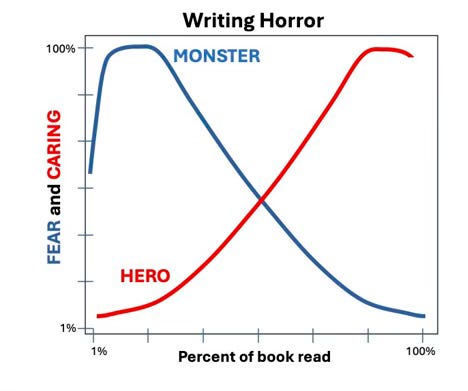
Here are some movie and book examples that follow the graph. All right, mostly movies.
Ripley is determined to save Newt from the Alien (with acid saliva(!) in Aliens (1986), the BEST of that movie franchise. The stakes are RAISED through the roof, and you are rooting for the bad*ss mother in the end, even though the alien is protecting her offspring, too, by colonizing every human with her protomorph babies.
In a really nice twist, David is both the Hero and the Monster in American Werewolf in London (1981). You so want him to win in the end. Alas.
First off, don’t read Peter Benchley’s Jaws (1974). The movie is much, much better.
Brody is the everyman, and when he lifts his shirt to expose his appendix scar or utters, “You’re gonna need a bigger boat,” you are right there beside him thinking, “What the heck have I gotten myself into?”
Then there is the shark. Think of the primal fear of the first scene as the woman is hit by something below, her breath coming in panicked puffs, screaming in unimaginable pain and pure terror until she’s pulled beneath for the last time.
While watching this scene, I made the astute and balanced decision to never go into the ocean again.
By the time I reached the end of the movie, the whole theater was laughing when the large rubber prop jumped in the boat, its jaws bouncing, boing! boing! boing! up and down on Quint—a lot of it was to relieve the tension.
Jaws (1975) is the epitome of the graph that accompanies this article.

Honorable mentions:
Tremors (1990) is a horror, comedy, action, thriller. It’s Jaws in the desert with a monster under the goll-durn ground, a great cast with great chemistry, and just watch it.
Fright Night (1985) is ANOTHER horror, comedy, action movie with a huge added dose of campy makeup and props. A vampire moves in next door to Charlie, who starts to investigate when he notices women going in but never coming out of his new neighbor’s home. In the end, Charlie is willing to sacrifice himself to save his friends. Go, Charlie!
And remember, as you watch and read horror, and write your own tales of terror, the object of ANY story is to make your reader/viewer care so much about the hero/heroine and their stakes that they won’t take their eyes off the page/screen.