
Let's talk about AI and "perfect beats" in fiction
When people think about AI “tells” in fiction, they usually start with language or clichés, or what I call “franchised phrases", but there’s a quieter signal that’s beginning to attract attention. ♣️


As authors in a churning, chaotic publishing industry—both traditional and especially indie—we have disagreements about the use of AI in our writing. I’m not so worried about it because I (personally) don’t use it for “writing”. I write my story, then use it for revising—sharpening themes and addressing excess backstory and narrative. But I am very careful about letting AI take over (oh, and it tries) because I have in the past, and it was pointed out by a beta reader (Thank you, Anna!)
I also like to use it for a light-touch proof before I send it to my human editor and proofreader. And I really love one of the writer programs, PWA, for helping me with story structure and story beats. This program gives me a plotline—my Narrative Tension flow—like rising action and crisis/climax. It also points out places where I could “tighten” my structure/plot points during revision.
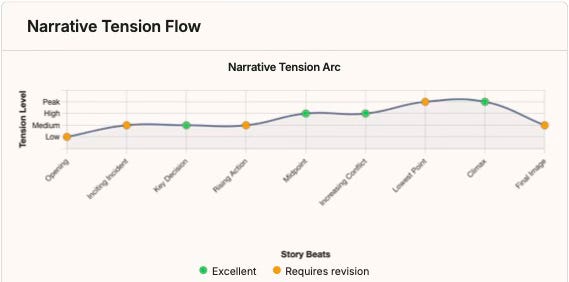
But more and more, writers and readers are “suspicious” about the use of AI on a grander level, and, sure enough, a tidal wave of AI “slop” is drowning out books written by real human voices. There’s even a logo authors can stamp on their books to tell the reader, Hey! This was written by a human, not a computer.
Where “perfect beats” look suspicious
When people talk about AI “tells” in fiction, they usually start with language or clichés, or what I call “franchising phrases, but there’s a quieter signal that’s beginning to attract attention. It’s the way some stories hit their structural beats with machine‑like precision. If you hand a capable AI model a template—like Hero’s Journey, Save the Cat, a 15‑ or 27‑beat grid—and tell it to “follow this,” it will tend to do so much more cleanly than most humans ever do in the wild. The result can be a narrative whose inciting incident, first plot point, midpoint reversal, and “dark night of the soul” land at unnervingly regular intervals in the word count, with each turning point articulated almost as if it knows it’s a turning point.
This is especially noticeable in short and medium‑length fiction, where there’s less room for coloring outside the lines. A 3,500‑word story that introduces its problem by paragraph three, pivots exactly at the halfway midpoint, and resolves everything in the last 10% with military adeptness might feel wonderfully efficient—or suspiciously too perfect. Humans can do this, of course, and good craft books encourage something like it, but most human drafts carry suggestions of the drafting struggle. Backstory and narrative are my dragons to slay, and over-describing a setting. Does the reader really need to know about the dainty lace draped over the back of a reading chair, or do I just want to use the word “antimacassar”? But what about a scene that runs a little long, a reaction beat that arrives a little late, a moment that breaks the formula in order to stay true to the character?
AI, when asked for “strong structure,” often over‑corrects toward visible bones. You’ll see beats that are not only in the right places but practically flagged red and flashing. For example, characters articulating their own low point:
Would she ever love him? He’d tried desperately to change but had failed because he hated to bathe. And then depression set in …
Explicit statements of theme at the midpoint:
He realized his past inability to confront his father about his terrible childhood was fading, but not yet completely gone. In fact, it seemed he was about halfway there …
Tidy echoes between opening and closing that feel placed rather than organically grown. In some cases, you can feel the ghost of the outline under the prose, as if someone copy‑pasted from a beat sheet and then filled in paragraphs.
BUT THIS CAN ALSO BE VERY HUMAN(!)
On its own, this “perfection in beats” is only a soft clue. Many human writers—especially those steeped in screenwriting and commercial genre craft—also aim for beat‑perfect work and sometimes hit it. Khan Academy’s PIXAR IN A BOX is actually used to teach this structural perfection. What makes “perfect beats” suspicious is not precision itself but precision combined with a lack of friction. Have all of the stubborn scenes that refuse to fit been cut? What about all those messy character emotions confuse a beat’s supposed purpose? When reading, you get no sense that the author ever had to choose between beautiful, structural elegance and the mess that’s left by the crappy first draft. It’s like the perfect model home without the comfortable dog smell in the sofa and that place on the wall where you measured your children’s growth every year.
It can all be very confusing, and right now it feels like Salem when people were yelling “witch” because that poor old widow owned a black cat.

So be careful who you accuse of being an AI author because AI has a way of listening and changing. Write your stories with or without help and find a way to get them to your readers. That’s job enough without the pitchforks and torches.
♣️