
Do you want to write a middle grade mystery?
Next is Beat 2 – Show the Big Problem and Expose the Crime

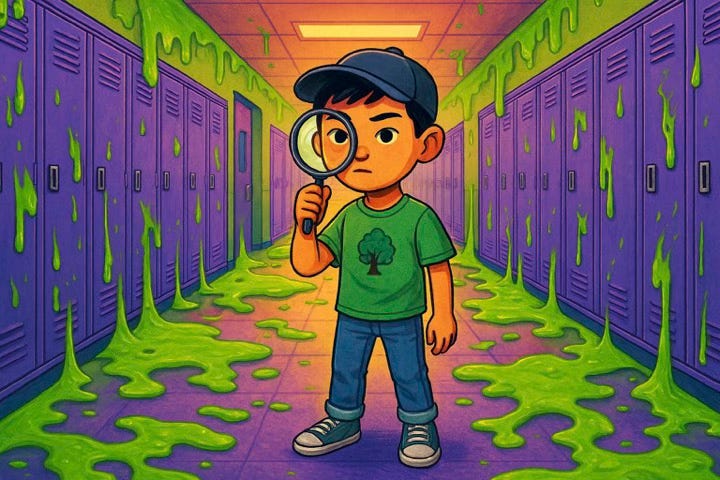
Every mystery needs a big problem to solve. “Expose the Crime” is the moment when that problem shows up, and your characters can’t ignore it anymore.
Your “crime” doesn’t have to be murder or anything super dark.
It can be:
A stolen championship trophy
A missing class pet
A hacked school account
A ruined science fair project
Something weird that clearly shouldn’t be there—like slime in every single locker
This beat has three important parts:
The event – What exactly happened? Say it clearly so readers know what needs to be fixed. “The principal’s golden whistle is gone,” or “Every basketball net in the gym has been cut to shreds.”
The questions – Who did this? How did they do it? Why would anyone want to? What will happen if nobody figures it out—no game, no field trip, someone gets expelled?
The shockwave – How does everyone react? Maybe kids freak out and or think it’s hilarious because the principal is a menace with that stupid whistle, maybe rumors explode on group chats, maybe teachers blame the wrong person, or the adults pretend it’s “no big deal” when everyone knows it is.

Sometimes your sleuth and the reader see the crime happen in real time—a shadowy figure dumping slime into lockers. Other times, they only see the mess later—like walking into homeroom and finding every desk flipped over(!) Both ways work, as long as this beat makes one thing crystal clear:
Here is the main mystery. This is the problem we have to solve.
By the end of Beat 2, your readers should know what went wrong, why it matters, and feel that itch in their brain that says, “Okay, now I have to know who did this.”
Would you like a mystery-writing guide? Check this out!